Guest
Guest Help & Contact
 HOW IT WORKS

 SELL
SELL
 SIGN IN
 WHY US
 Safe and secure payments. 100% Satisfaction Guaranteed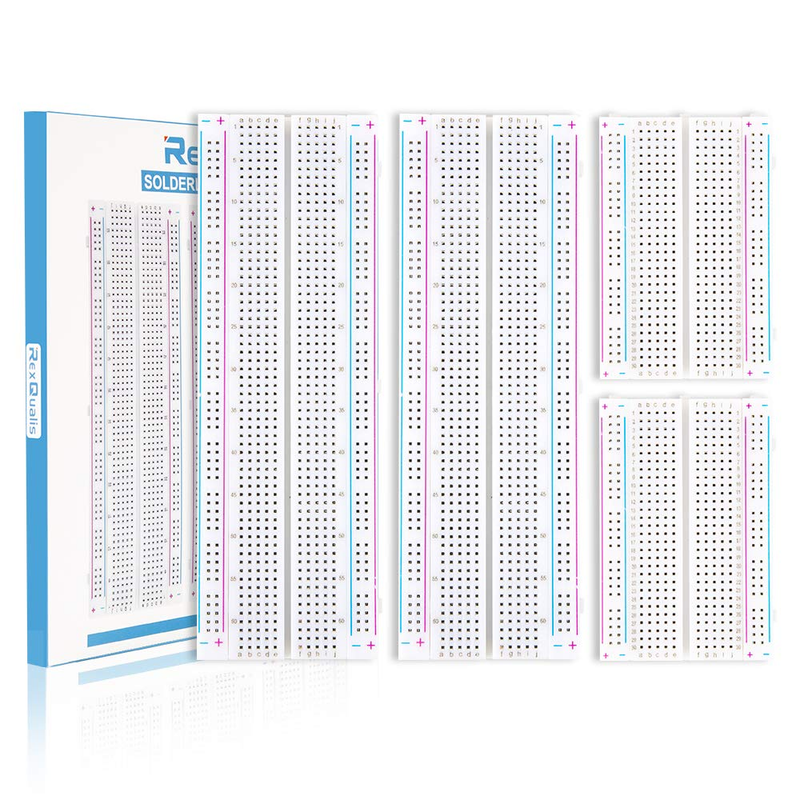




4PCS Breadboards Kit Include 2PCS 830 Point 2PCS 400 Point Solderless Breadboards

- 400 point and 830 point breadboards are available to meet your various experimental needs.
- White ABS Plastic Body with Black Printed Legend. Color Legend on Distribution Strips.
- With Self-Adhesive Tape on the Back, Easy to Stick on the Arduino Prototype Shield.
- Inter Connect Any Components with 20-29 Awg (0.3-0.8mm) Wire.
- Good for Arduino Breadboard Jumper Wires kit Project and other Electrical DIY kits.
Product description
What is breadboard?
Breadboard is a solderless device for temporary prototype with electronics and test circuit designs. Most electronic components in electronic circuits can be interconnected by inserting their leads or terminals into the holes and then making connections through wires where appropriate.
The breadboard has strips of metal underneath the board and connect the holes on the top of the board. Note that the top and bottom rows of holes are connected horizontally and split in the middle while the remaining holes are connected vertically.
The Breadboards Can be Spliced According to the Unit, the Structure is Clear in Color.
The Breadboards is 2-Sided Peelable Adhesive Tape,Easy to Stick on the Prototype Shield,Suitable for Line Prototype Design.
Large Breadboards (830 points):
· 630 tie-point IC circuit area
· 4 power rails (2x100 tie-point distribution strips)
Small Breadboards (400 points):
· 300 tie-point IC circuit area
· 4 power rails (2x50 tie-point distribution strips)
Key Features:
· Material: ABS plastic panel with tin-plated phosphor bronze contact sheets
· Wire Compatibility: 20-29 AWG wires (0.3-0.8mm)
· Power Rating: 300V/3-5A
· Adhesive Backing: 2-sided peelable tape for easy mounting
· Color-coded: Clear color legend on distribution strips
· Modular Design: Breadboards can be connected together
What's Included:
- 2 large breadboards with 830 tie points each
- 2 smaller breadboards with 400 tie points each
Perfect For:
- Arduino projects and prototype shields
- Electronics prototyping and experimentation
- Educational electronics projects
- DIY circuit design